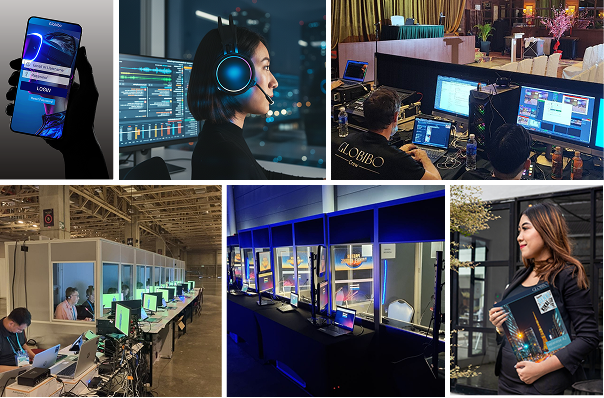
Globibo delivers full-service conference interpretation services, pairing elite AIIC-aligned linguists with enterprise-grade interpretation equipment and ISO-compliant soundproof booths across Singapore, Malaysia, Hong Kong, and international event destinations. Explore our specialized conference interpreter network (.Asia) and master guide to simultaneous interpretation technology.
Defining Conference Interpretation: Modes, Standards & Architecture
Unlike general community or escort interpreting, conference interpretation operates under strict international benchmarks governed by ISO 18841 (Basic Principles and Qualification of Interpreters) and ISO 20108:2017 (Audio/Video Quality Requirements for Interpretation). It is primarily delivered via two core modalities:
| Operational Parameter | Simultaneous Conference Interpretation | Consecutive Conference Interpretation |
|---|---|---|
| Delivery Workflow | Real-time concurrent translation (2–3 seconds delay; no speaker pauses) | Sequential translation during natural pauses after speaker segments (1–5 mins) |
| Linguist Staffing | Minimum 2 interpreters per language booth rotating every 20 minutes | Typically 1 interpreter for sessions under 2 hours; 2 for full-day sessions |
| Hardware Required | ISO 17651 soundproof booths, digital consoles, IR/RF radiators, delegate headsets | Standard podium microphones and room PA system; note-taking notation pad |
| Event Schedule Impact | Zero time added; maintains strict plenary conference timelines | Doubles session duration due to alternating speech delivery |
| Optimal Conference Format | Multilateral plenary summits, international congresses, global town halls | Press conferences, bilateral VIP banquets, legal witness depositions |
Technical Infrastructure: ISO Booths, Consoles & Signal Distribution
Delivering broadcast-quality conference interpretation requires a calibrated audio transmission chain:
- ISO 17651-2:2024 Acoustic Booths: Transportable mobile booths engineered with sound reduction ratings ($R’w \ge 28\text{ dB}$) and silent mechanical ventilation ($<30\text{ dB(A)}$) to isolate interpreters from plenary acoustics.
- Digital Interpreter Consoles (ISO 20108): Microprocessor-controlled consoles providing acoustic shock limiting, relay channel switching, and direct balanced line audio feeds.
- Infrared (IR) vs. Radio Frequency (RF) Distribution: High-security Infrared radiators prevent signal leakage beyond ballroom walls for confidential arbitrations, while RF systems provide wide-band coverage across sprawling convention halls.
- Delegate Multi-Channel Receivers: Lightweight wireless receivers with ergonomic headsets enabling attendees to select their preferred language channel instantly.
The Human Factor: Cognitive Load, Dialects & The 20-Minute Rotation Rule
Cognitive scientific research (Gile’s Effort Model and Seeber’s Cognitive Load Model) confirms that simultaneous conference interpretation is among the most cognitively demanding professional activities. Interpreters listen, analyze context, anticipate syntax, and speak concurrently. After 20 to 30 minutes of continuous delivery, cognitive fatigue increases sharply, causing an elevation in micro-errors.
To ensure 99%+ linguistic fidelity, Globibo strictly enforces the 20-minute rotation principle: interpreters work in synchronized pairs within each booth, alternating active microphone duty while the off-mic partner monitors terminology, tracks numerical figures, and reviews presentation glossaries.
Real-world Case Studies: verified Conference Deployments by Globibo
- Multi-Language Conference Booth Deployment (Seoul): Deployed 4 parallel ISO booths, digital consoles, and wireless transmission for 380 international delegates covering English, Korean, Thai, and Mandarin. Read the full case study: Multilingual Communication Support for a Regional Event in Seoul.
- Singapore Event Management & Production House Support: Provided full on-site AV engineering, frequency management, and interpretation infrastructure for a major Singapore event agency. Review the case study: Event Tech & RSI Services for a Singapore Production Company.
- High-Density Medical & Technical Summit: Deployed hybrid human-verified interpretation systems to ensure zero terminology errors during complex surgical congresses. Explore the project details: Combining Human Expertise and AI Interpretation for Medical Forums.
- Multi-Location Risk Mitigation & RSI: Synchronized live interpretation feeds across distributed geographic conference centers with zero audio latency. Read more: Improving Participant Experience with Multi-Event Setup.
Key Articles on Conference Interpretation (Knowledge Base)
1. Hiring Interpretation Equipment for Your Conference
Explore technical equipment selection criteria, including infrared radiators, transmitters, and delegate receiver counts for major convention halls.
2. How Can You Ensure Superior Quality of Simultaneous Interpretation in a Conference?
Discover key quality assurance workflows, including speaker briefing protocols, audio line isolation, and terminology glossary preparation.
3. When Should You Choose a Remote Interpreter Instead of a Local Interpreter?
Evaluate the trade-offs between on-site conference linguists and cloud-based Remote Simultaneous Interpretation (RSI) for international symposiums.
4. Simultaneous Interpretation Tips for Event Planners
A comprehensive checklist covering booth placement, line-of-sight requirements, and audio technician-to-room ratios.
5. Interpreting in Diplomatic and Legal Settings
Protocol guidelines, confidentiality standards, and sworn accreditation requirements for governmental assemblies and international arbitrations.
6. Merits of Language Interpretation vs. Translation
Clarifying the critical distinction between real-time spoken language interpretation and written document localization.
7. Why It Is Important to Hire a Qualified Simultaneous Interpretation Company
How professional language partners mitigate operational risks, prevent audio feedback loops, and protect brand reputation.
8. Benefits of Remote Simultaneous Interpretation (RSI)
Learn how cloud-based interpretation platforms scale multilingual access across global hybrid conferences and webinars.
9. Merits of Hiring Certified Conference Interpreters
Understanding the rigorous vetting, academic training, and subject-matter expertise required for simultaneous conference delivery.
10. Future of the Language Interpretation Industry
Analyzing the integration of AI-assisted terminology tools, hybrid cloud architectures, and neural audio processing in conference interpreting.
11. Interpretation Systems and ISO Acoustic Booth Infrastructure
Engineering standards, ventilation rates, and sound isolation requirements for mobile and permanent interpretation booths.
12. Working Languages for a Conference Interpreter
How conference linguists categorize A (native), B (active), and C (passive) working languages under international standards.
13. Ways of Speaking to a Multilingual Audience
Practical speaker guidelines for pacing, idiom avoidance, and slide clarity during simultaneously interpreted international presentations.
14. What is the Job of a Simultaneous Conference Interpreter?
A deep dive into the cognitive workflows, decalage management, and live linguistic synthesis required inside the booth.
15. Why Should You Get Portable Translation Equipment?
Exploring wireless tour-guide systems and portable transmitters for dynamic multi-room workshops and site inspections.
16. Types of Language Interpreters: Modality Selection Guide
Comparing simultaneous, consecutive, whispered (chuchotage), and liaison interpretation for corporate meetings.
17. Remote Interpreting: Everything You Should Know
A complete guide to bandwidth management, platform integration (Zoom, Teams, Webex), and virtual audio routing.
Author & Localization Specialist

Susan Tan
Senior Localization & Conference Interpretation Specialist
Susan oversees conference interpretation operations, governmental summit workflows, and multi-hub event technology setups across Singapore, Malaysia, and Hong Kong. With extensive experience managing technical compliance at Sands Expo, Suntec, and regional convention centers, she ensures flawless multilingual execution.
Email: susan.tan@globibo.com | Case Studies: Singapore Event Tech Support | Portfolio: Interpretation Portfolio (.Asia)
FAQs on Conference Interpretation
Q1: What qualifications are required for a professional conference interpreter?
Professional conference interpreters typically hold master’s degrees in conference interpretation, possess native fluency in their primary working languages, hold verified professional accreditation (such as AIIC alignment or court certification), and have extensive domain knowledge in specific fields such as medicine, law, or engineering.
Q2: How far in advance should conference interpretation services be booked?
For major international conferences, we recommend booking 4 to 8 weeks in advance. This lead time ensures availability of top-tier native interpreters for specific language combinations and allows 48 to 72 hours for thorough pre-conference terminology glossary preparation.
Q3: What materials must event organizers provide to interpreters before the conference?
Organizers should provide presentation slide decks, speech outlines, speaker biographies, session agendas, and industry-specific terminology glossaries at least 48 to 72 hours prior to the event.
Academic & Industry Standards References
- ISO 17651-2:2024: Simultaneous interpreting — Mobile booths — Requirements. International Organization for Standardization.
- ISO 20108:2017: Simultaneous interpreting — Quality and transmission of sound and image input. International Organization for Standardization.
- Seeber, K. G. (2011). Cognitive load in simultaneous interpreting: Existing models—new perspectives. Interpreting, 13(2), 176–204.
- Gile, D. (2009). Basic Concepts and Models for Interpreter and Translator Training. John Benjamins Publishing Company.
- Bartłomiejczyk, M., & Stachowiak-Szymczak, K. (2020). Modes of conference interpreting: Simultaneous and consecutive. Perspectives, 28(4), 512–528.