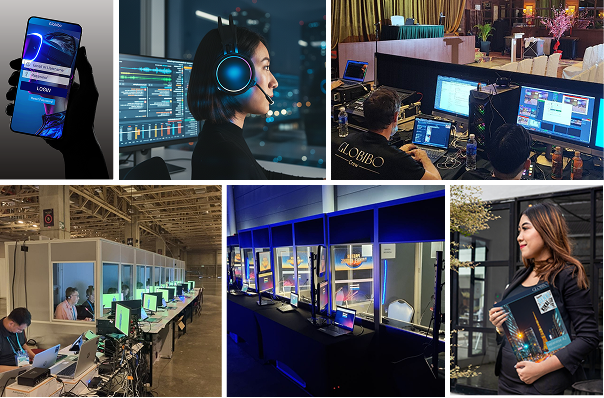
A Mobile Interpreting System delivers interpreted speech to participants through compatible smartphones, tablets, laptops or portable receivers. It supports multilingual conferences, meetings, training programmes and guided visits where attendees need to follow speakers in another language. The configuration depends on the event format, audience size and required language combinations.
Globibo plans the interpretation workflow, equipment, language channels and participant access around venue connectivity, privacy and operational requirements. Choose personal-device listening, portable wireless receivers or a combined setup, with professional linguists and technical support.
The objective is to maintain access to interpreted audio across the programme.
Request a Mobile Interpreting System Consultation

Mobile Interpreting System Overview
A Mobile Interpreting System allows participants to listen to interpreted speech without necessarily remaining connected to a fixed interpretation receiver or listening station. Depending on the selected configuration, attendees can use their personal devices or dedicated portable wireless receivers.
Personal-device interpretation is suitable for events where participants can access a configured browser-based platform or application through the venue network or mobile internet. The available language channels are selected through the participant interface.
Portable interpretation systems use transmitters and receivers to distribute interpreted audio wirelessly. They are particularly relevant for guided visits, educational programmes, factory tours and other activities where participants move between locations.
Globibo’s Language Services offering combines its own interpreting equipment stock and AI-platform capabilities with the selection, preparation and support of linguists. This combination supports different interpretation requirements, from personal-device access to equipment-based mobile deployments. Globibo provides Language Services solutions with unrivaled speed, cost-efficiency, and quality to empower & engage People in Communication.
The choice of system should account for the number of participants, language combinations, venue connectivity, audio infrastructure and confidentiality requirements. A smartphone can simplify receiver distribution, but it does not replace the microphones, interpreter workflow or audio monitoring required to deliver the service.
For event organizers, the main operational consideration is how participants access the correct language channel and continue listening when they move between rooms or locations.

System Options & Operating Mechanism
Mobile interpretation can be delivered through different technical configurations. The appropriate option depends on whether participants use personal devices, dedicated receivers or a combination of both.
Personal Device Interpretation
Personal-device interpretation allows attendees to listen to interpreted audio using compatible smartphones, tablets or laptops. Depending on the platform, access can be provided through a browser, mobile application or another configured joining method.
For an Events.Studio deployment, participants can access a configured landing page and select their preferred language channel. A QR code can be used to direct attendees to the relevant access page, reducing the need to distribute individual listening receivers.
This approach is suitable for conferences, corporate meetings and hybrid programmes where participants have compatible devices and reliable network access.
Portable Transmitter and Receiver Systems
Portable wireless interpretation systems use mobile transmitters and receivers to distribute interpreted audio to participants. The interpreter or guide speaks into a transmitter microphone, while participants listen through compatible receivers and headphones.
This configuration is useful for walking tours, factory visits, educational excursions and other programmes where the group moves through different locations. It also provides an alternative for participants who cannot use personal devices or where internet access is unsuitable.
Equipment requirements can include:
- Mobile interpretation transmitters.
- Transmitter microphones.
- Portable interpretation receivers.
- Headband headphones or compatible listening accessories.
- Charging cases and charging infrastructure.
- Audio splitters and volume mixers, where required.
- Technical support for setup, testing and operations.
Hybrid Interpretation Configuration
Some events require both personal-device access and dedicated interpretation equipment. A hybrid configuration can accommodate participants using compatible smartphones alongside attendees who require portable receivers.
This arrangement is particularly relevant for international programmes involving different participant groups, venue restrictions or varying device availability.
Participant Access and Language Selection
The participant interface should clearly identify the available language channels. Attendees need to know how to access the session, select a language and adjust their listening volume.
The joining instructions should be distributed before or during registration, with assistance available at the venue. A QR code can shorten the access process, but it cannot tell an attendee which language channel to select unless the instructions are clear.

Technical Setup and Interpretation Standards
A Mobile Interpreting System requires coordination between audio input, interpretation delivery, distribution infrastructure and participant devices. The technical plan should be prepared according to the venue, audience density, network conditions and interpretation requirements.
Audio Input and Interpreter Distribution
The speaker’s microphone audio must reach the interpreter through the planned interpretation workflow. For onsite conferences, this may involve routing audio from the venue mixing console or conference microphone system.
For remote and hybrid events, the audio workflow must also accommodate remote speakers, playback content and online meeting feeds. The interpreted audio is then transmitted through the selected platform or wireless distribution system.
Audio monitoring should cover both the incoming source signal and the interpreted language channels. Echo, feedback and incorrect routing can affect the listening experience, particularly when multiple devices and microphones operate in the same room.
Network and Platform Requirements
Personal-device interpretation depends on suitable network connectivity. Venue Wi-Fi coverage, audience density, network restrictions and mobile data availability should be assessed before deployment.
Representative smartphones and tablets should be tested in the actual event environment. Network performance in an empty conference room may differ considerably from conditions when hundreds of attendees connect simultaneously.
Device Compatibility and Backup
The selected platform should be tested on the devices participants are expected to use. Organizers should also consider battery life, headphone availability, browser compatibility and access permissions.
For events where personal-device access is the primary method, portable receivers can be considered as a backup. Alternatively, an approved secondary network or another listening arrangement can be included in the contingency plan.
Information Security and Relevant ISO Standards
Globibo maintains certification against ISO 18841:2018 for interpreting services, ISO 27001 for information security management and ISO 20121 for event sustainability management.
Other technical standards provide relevant guidance for interpretation delivery and equipment:
- ISO 18841:2018: General requirements and recommendations for interpreting services.
- ISO 24019:2022: Requirements and recommendations for simultaneous interpreting delivery platforms, including remote interpretation environments.
- ISO 20108:2017: Quality and transmission of sound and image for simultaneous interpreting.
- ISO 20109: Requirements for simultaneous interpreting equipment.
- ISO 27001: Information security management systems and organizational information protection.
- ISO 20121: Event sustainability management systems.
ISO 24019, ISO 20108 and ISO 20109 provide relevant technical guidance but should not be presented as Globibo certifications. ISO 17100:2015 concerns translation services rather than mobile interpreting technology.
For projects involving confidential meetings, government programmes or restricted-access sessions, organizers should establish participant permissions, recording settings, data handling and retention requirements before deployment.
A technical rehearsal is preferable to discovering audio feedback during a live presentation. Testing should include the actual microphones, interpreter feeds, network conditions and representative participant devices.
Applications & Project Requirements
Mobile interpretation is suitable for multilingual programmes where participants need access to interpreted speech while remaining in different rooms, moving through venues or joining remotely.
International Conferences & Summits
International conferences can use personal-device interpretation to provide access to selected language channels. Attendees can listen through compatible devices while organizers coordinate the interpretation feeds and participant access.
Corporate Meetings & Training
Corporate meetings, management briefings and training programmes frequently involve international participants. Mobile interpretation can support multilingual communication in classrooms, meeting rooms and temporary training locations.
Guided Visits & Educational Programmes
Guided visits require participants to move while continuing to listen to the guide or interpreter. Portable transmitters and receivers are particularly useful when a fixed interpretation booth or conventional conference setup is impractical.
Applications can include university visits, industrial facilities, exhibitions, museums, airport tours and educational excursions.
Government & Diplomatic Programmes
Government meetings and diplomatic programmes may involve multiple language combinations, controlled participant access and several parallel sessions. The interpretation configuration should account for confidentiality, authorized access and the number of participants in each room.
The right system depends on the movement of participants, the number of language channels and the technical infrastructure available at each location.
Mobile Interpretation Case Studies
Globibo has delivered mobile and remote interpretation solutions for conferences, educational programmes and large-scale organizational events. The following projects illustrate different approaches to participant access, portable equipment and multilingual audio distribution.
| Project | Scope and Challenge | Solution and Result |
|---|---|---|
| 100+ Delegates Bali, Indonesia |
An international conference required interpreted audio for more than 100 delegates. Participants were expected to use their own devices despite variable internet connectivity. | Events.Studio provided a customized landing page with QR-code access and selectable audio channels. The team conducted interpreter rehearsals and monitored incoming and interpreted audio feeds. Most participants experienced stable access despite patchy venue connectivity. |
| 1,400 Participants Hong Kong |
An insurance-sector annual kick-off conference combined onsite and remote attendance. Participants required Cantonese and Mandarin interpretation, while poor venue connectivity presented an operational challenge. | Globibo deployed Events.Studio with Zoom integration, dedicated language channels and audio monitoring. Participants accessed the platform through a QR code and selected their preferred language. The project included onsite technical support and remote streaming management. |
| 37 Participants 6-Day Training Programme, Singapore |
A college required interpretation support for 37 participants throughout a 6-day in-person training programme, with 1 language combination. | The setup included 1 conference interpretation booth, 2 interpreter consoles, 2 full-range interpretation transmitters, 2 mobile transmitters, 2 transmitter microphones, 37 receivers and 37 headband headphones. Two standby technicians supported operations, and rehearsals were conducted 1 hour before each event. |
These projects demonstrate the different configurations available for mobile interpretation. Personal-device access is appropriate for suitable network and platform environments, while portable transmitter and receiver systems remain useful for physical programmes and guided activities.
Globibo has also supported large government programmes combining interpretation across 3 parallel rooms, a conference mobile application and attendee access control for 3,500 foreign delegates.
Read the Government Event Case Study
Why choose us?
Selecting a mobile interpreting system involves more than choosing an application or a set of receivers. The interpretation workflow, equipment, language channels, venue connectivity and participant support must operate together.
Globibo combines its own interpreting equipment stock with AI-platform capabilities and a structured approach to linguist selection, preparation and support. This provides access to both equipment-based and technology-assisted interpretation arrangements.
The company’s experience includes personal-device interpretation, remote interpretation, portable wireless equipment, simultaneous interpretation and technical support for multilingual programmes. Our Mission & Vision is to Maximize the Potential of People, Content & Events. Mobile interpretation supports this objective by making spoken information accessible to participants across different languages and event environments.
Speak with Experts

Susan Tan
Localization Expert
Location: Singapore
Email: susan.tan@globibo.com
Contact: +65 6589 8817
Case Study: Multilingual Interpretation for a High-Profile Global Media Gathering in Korea
News: Relevant Susan Tan News
Portfolio: Interpreting Portfolio
Description: Susan has extensive experience in conference interpretation, simultaneous interpretation, and document localization for governmental and legal needs. Her work with embassies and government agencies supports multilingual projects requiring regional and language-specific expertise.
Request a Mobile Interpreting System Quote
Share your event date, duration, language combinations, participant numbers, venue details and preferred listening method. Globibo can assess the appropriate interpretation configuration and technical requirements.
Frequently Asked Questions
1. What is a Mobile Interpreting System?
A Mobile Interpreting System delivers interpreted audio to participants through compatible smartphones, tablets, laptops or dedicated portable receivers. The configuration depends on the event format and participant requirements.
2. Can participants use their own smartphones?
Yes, when the selected platform, smartphone, network and event configuration support personal-device listening. Organizers should provide joining instructions and consider an alternative for participants who cannot use their own devices.
3. Does a Mobile Interpreting System eliminate the need for interpretation equipment?
Not necessarily. Personal-device access can reduce the requirement for dedicated listening receivers in suitable environments, but microphones, audio routing, interpretation infrastructure, connectivity and technical support are still required.
4. Does every participant need to install an application?
Not necessarily. Depending on the platform configuration, participants may access interpreted audio through a browser, mobile application or another approved joining method.
5. Can mobile interpretation support multiple languages?
Yes. Multiple language channels can be configured according to the interpretation plan, interpreter availability and platform capacity. The required language combinations should be confirmed before the event.
6. Can a Mobile Interpreting System support hybrid events?
Yes. A suitable configuration can support onsite and remote participants. The audio workflow must account for room microphones, remote speakers, original-language audio and interpreted feeds.
7. What happens if the venue internet connection fails?
The project should include a connectivity assessment and contingency plan. Depending on the deployment, alternatives may include another network connection, technical support or dedicated interpretation receivers.
8. What information is required for a quotation?
Organizers should provide the event date and duration, language combinations, participant numbers, venue or online platform, onsite and remote attendance split, preferred device configuration and any privacy or accessibility requirements.
9. Can mobile interpretation be used for factory tours and educational visits?
Yes. Portable transmitters and receivers are suitable for guided visits, industrial facilities, educational excursions and other activities where participants move between locations while listening to an interpreter or guide.
10. What standards are relevant to mobile interpretation?
ISO 18841:2018 provides general requirements and recommendations for interpreting services. ISO 24019:2022, ISO 20108 and ISO 20109 provide additional guidance relevant to simultaneous interpreting platforms, sound transmission and equipment. Information security requirements should also be considered where applicable.