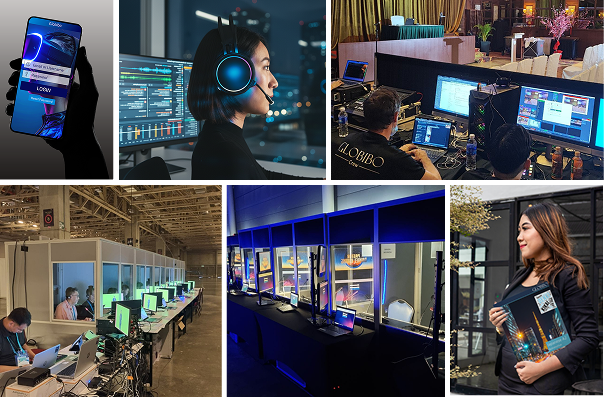
Abstract
Simultaneous interpretation is a mission-critical communication technology for multilingual events. This 2026 guide provides a technical and operational overview of simultaneous interpretation, including system architecture, equipment components, booth standards, and hybrid and remote deployment models. The article is designed as a reference resource for organizations planning conferences, corporate meetings, government events, and global forums.
1. Definition of Simultaneous Interpretation
Simultaneous interpretation is a real-time language interpretation method in which spoken content is translated into one or more target languages without interrupting the speaker. Interpreters listen to the source language and deliver the translation with a short delay, typically between 2 and 5 seconds.
This approach is preferred when:
- Multiple languages are required
- Event schedules are time-sensitive
- Audience size is large
- Communication flow must remain uninterrupted
2. Where Simultaneous Interpretation Is Used
By 2026, simultaneous interpretation is standard practice for:
- International conferences and summits
- Government and intergovernmental meetings
- Shareholder meetings and AGMs
- Corporate town halls and internal communications
- Medical, scientific, and technical congresses
- Legal and regulatory proceedings
- Multilingual training programs
Any event involving real-time multilingual participation benefits from effective simultaneous interpretation systems.
3. System Architecture of Simultaneous Interpretation
A professional simultaneous interpretation tool setup is built on four integrated technical layers:
- Source Audio Capture Layer
- Interpreter Processing Layer
- Audio Distribution Infrastructure
- Audience Access Layer
Each layer must operate with low latency, high audio fidelity, and operational redundancy to ensure uninterrupted interpretation delivery.
4. Core Components of a Simultaneous Interpretation System
a. Interpretation Booth
An interpretation booth provides a controlled acoustic environment that allows interpreters to work accurately without interference from ambient noise.
Technical Characteristics
- Sound insulation and acoustic treatment
- Silent ventilation systems
- Visual access to speakers or presentation screens
- Compliance with international standards (ISO 4043 / ISO 2603)
Common Booth Types
- Fixed ISO booths for permanent installations
- Portable modular booths for conferences and summits
- Tabletop or mobile booths for smaller meetings or limited spaces
b. Interpreter Console
The interpreter console functions as the interpreter’s operational control unit.
Key Capabilities
- Language channel selection
- Relay interpretation management
- Input and output volume control
- Microphone activation and muting
- Seamless switching between source and relay channels
Modern digital interpreter consoles support multi-language and multi-relay configurations, essential for international events with complex language requirements.
c. Interpretation Equipment
Professional interpretation relies on specialized simultaneous interpretation equipment designed for reliability and clarity.
Typical Equipment Includes
- Noise-isolating interpreter headsets
- Interpreter microphones
- Digital audio transmitters
- Audience receivers or mobile listening endpoints
- Channel monitoring and control units
- Power management and redundancy systems
High-quality interpretation equipment ensures:
- Minimal latency
- Stable signal transmission
- Clear, distortion-free audio
- Resistance to interference in large venues
d. Audience Reception Systems
Audience members access interpreted audio through:
- Wireless receivers with headphones, or
- Mobile-based interpretation applications, typically accessed via QR codes
By 2026, mobile-based delivery is increasingly common, allowing attendees to select languages directly from their own devices.
5. Silent Conference Systems
A silent conference system replaces traditional loudspeaker setups with individual listening devices.
Technical Advantages
- Multiple sessions running simultaneously in the same space
- Reduced ambient noise levels
- Improved speech intelligibility
- Efficient multilingual scalability
Silent conference systems are widely used in exhibitions, workshops, training environments, and multi-track conferences.
6. Simultaneous vs Consecutive Interpretation
| Parameter | Simultaneous Interpretation | Consecutive Interpretation |
| Delivery | Real-time | Speaker pauses |
| Event duration | Optimized | Extended |
| Equipment | Required | Optional |
| Scalability | High | Limited |
| Best suited for | Conferences, AGMs | Small meetings |
For medium to large events, simultaneous interpretation remains the most efficient model.
7. Hybrid and Remote Interpretation Models
a. Hybrid Interpretation
Hybrid simultaneous interpretation combines on-site audio capture with remote interpreter participation.
Typical configuration:
- Speakers on-site
- Interpreters remote
- Audience on-site, online, or both
This model requires:
- Stable, low-latency connectivity
- Audio-video synchronization
- Integration with conferencing and hybrid interpretation platforms
b. Remote Interpretation
In remote interpretation, interpreters work entirely off-site using secure cloud-based platforms.
Operational Benefits
- Access to global interpreter talent
- Reduced travel and logistics costs
- Faster deployment timelines
- Business continuity for global organizations
By 2026, remote interpretation is firmly established as a standard delivery model rather than an exception.
8. Technical Challenges and Risk Mitigation
| Challenge | Mitigation Strategy |
| Audio latency | Digital low-latency transmission |
| Signal interference | Frequency planning and digital protocols |
| Interpreter fatigue | Dual-interpreter rotation |
| Hybrid complexity | Integrated event technology platforms |
| Device management | Centralized monitoring dashboards |
Professional system design and testing are essential to mitigate these risks.
9. Compliance and Standards
Simultaneous interpretation deployments often follow:
- International ISO booth standards
- Audio quality benchmarks
- Accessibility and inclusivity requirements
Compliance is particularly critical for:
- Government and diplomatic events
- Legal proceedings
- Regulated industries
10. Trends Shaping Simultaneous Interpretation in 2026
Key developments include:
- AI-assisted audio quality monitoring
- App-based audience delivery replacing hardware receivers
- Real-time analytics on language channel usage
- Hybrid-first interpretation architectures
- Increased focus on accessibility and inclusive design
Technology enhances efficiency while preserving the role of professional human interpreters.
11. Strategic Importance for Organizations
Simultaneous interpretation is no longer an auxiliary service. It is a core communication infrastructure enabling organizations to:
- Operate globally
- Maintain message consistency across languages
- Improve inclusivity and accessibility
- Reduce communication risk at high-stakes events
Summary of Simultaneous Interpretation
Simultaneous interpretation is a highly structured, technology-driven discipline that requires careful coordination between interpreters, equipment, and event infrastructure. When deployed correctly, it enables seamless multilingual communication without disrupting event flow or audience engagement.
As global collaboration continues to expand in 2026 and beyond, simultaneous interpretation systems should be planned as a technical deployment, not a last-minute add-on.
YouTube Video on Simultaneous Interpretation