
The German language, with its rich history and significant cultural influence, is one of the most widely spoken languages in Europe. Known for its precision and extensive vocabulary, German is the native language of over 100 million people and an official language in several countries, including Germany, Austria, Switzerland, and Luxembourg. Learning German opens doors to understanding not only the language but also the rich literature, philosophy, and scientific contributions made by German-speaking regions.
This guide aims to provide a comprehensive introduction to the fundamental aspects of German grammar and vocabulary, focusing on essential rules, structures, and common pitfalls. The content is structured to offer a systematic approach, allowing beginners to build a strong foundation in the language. The technical nature of this guide is designed to support both self-learners and those enrolled in formal language courses.
Overview of German Grammar
German grammar, while logical and structured, can be challenging for beginners due to its complexity and exceptions. However, understanding the key grammatical components is essential for mastering the language. This section provides a detailed analysis of the primary elements of German grammar, including sentence structure, cases, verb conjugation, and articles.
Sentence Structure
German follows a Subject-Verb-Object (SVO) order in simple sentences, similar to English. However, the position of the verb can vary in dependent clauses and questions, where it often moves to the end of the sentence.
- Simple Sentence (Main Clause):
- Example: Ich esse einen Apfel. (I eat an apple.)
- Dependent Clause:
- Example: Ich esse, weil ich hungrig bin. (I eat because I am hungry.)
- Question:
- Example: Isst du einen Apfel? (Are you eating an apple?)
German Cases
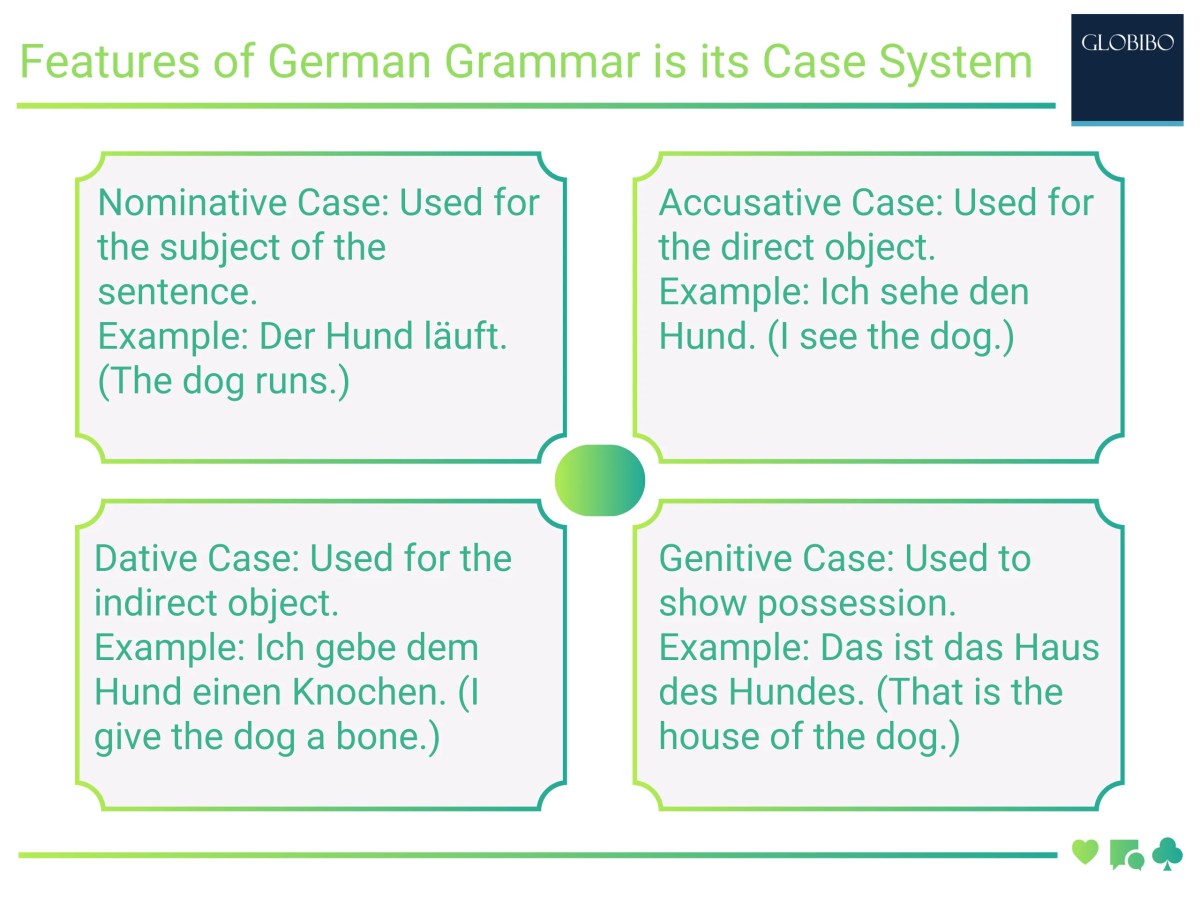
One of the most distinctive features of German grammar is its case system. German uses four cases: Nominative, Accusative, Dative, and Genitive. These cases indicate the grammatical function of a noun or pronoun within a sentence.
- Nominative Case: Used for the subject of the sentence.
- Example: Der Hund läuft. (The dog runs.)
- Accusative Case: Used for the direct object.
- Example: Ich sehe den Hund. (I see the dog.)
- Dative Case: Used for the indirect object.
- Example: Ich gebe dem Hund einen Knochen. (I give the dog a bone.)
- Genitive Case: Used to show possession.
- Example: Das ist das Haus des Hundes. (That is the house of the dog.)
Verb Conjugation
German verbs are conjugated based on the subject, tense, and mood. The three primary tenses in German are Present, Past (Perfect and Imperfect), and Future.
- Present Tense Conjugation:
- Example: Ich gehe (I go), du gehst (you go), er/sie/es geht (he/she/it goes)
- Past Tense Conjugation (Perfect):
- Example: Ich bin gegangen (I have gone), du bist gegangen (you have gone)
- Future Tense Conjugation:
- Example: Ich werde gehen (I will go), du wirst gehen (you will go)
Articles and Gender
German nouns have three genders: masculine, feminine, and neuter, which are indicated by the definite articles der, die, and das respectively. Additionally, German has indefinite articles (ein, eine), which also change based on the case.
- Masculine (der):
- Example: Der Mann (The man)
- Feminine (die):
- Example: Die Frau (The woman)
- Neuter (das):
- Example: Das Kind (The child)
The table below illustrates the changes in definite and indefinite articles across different cases:
| Case | Masculine (der/ein) | Feminine (die/eine) | Neuter (das/ein) | Plural (die/–) |
| Nominative | der/ein | die/eine | das/ein | die |
| Accusative | den/einen | die/eine | das/ein | die |
| Dative | dem/einem | der/einer | dem/einem | den (plus -n) |
| Genitive | des/eines (plus -s) | der/einer | des/eines (plus -s) | der |
Core Vocabulary and Word Formation
Vocabulary acquisition is a crucial part of language learning. German vocabulary is heavily influenced by its morphological structure, where compound words are commonly used. Understanding basic vocabulary, word formation, and the nuances of false cognates can greatly enhance your language proficiency.
Basic Vocabulary
The following list covers some essential German vocabulary across different categories:
- Greetings:
- Hallo (Hello)
- Guten Morgen (Good morning)
- Guten Abend (Good evening)
- Auf Wiedersehen (Goodbye)
- Common Verbs:
- sein (to be)
- haben (to have)
- machen (to do/make)
- gehen (to go)
- Numbers:
- eins (one)
- zwei (two)
- drei (three)
- vier (four)
- Days of the Week:
- Montag (Monday)
- Dienstag (Tuesday)
- Mittwoch (Wednesday)
- Donnerstag (Thursday)

Word Formation
German is known for its extensive use of compound words. These are formed by combining two or more words to create a new term, often resulting in long and descriptive nouns.
- Example of Compound Words:
- Krankenhaus (hospital) = Krank (sick) + Haus (house)
- Handschuh (glove) = Hand (hand) + Schuh (shoe)
Understanding the meaning of individual components can help deduce the meaning of complex words. Additionally, German makes use of prefixes and suffixes to modify the meanings of base words.
- Prefixes:
- be- (makes a verb transitive): bekommen (to receive)
- ver- (often denotes a change or error): verlieren (to lose)
- Suffixes:
- -heit (creates nouns indicating a state): Freiheit (freedom)
- -lich (creates adjectives indicating characteristics): freundlich (friendly)
False Cognates
False cognates, or false friends, are words that appear similar in German and English but have different meanings. Being aware of these can prevent misunderstandings.
| German Word | English Word | Actual Meaning in German |
| Gift | Gift | Poison |
| bekommen | Become | To receive |
| Billion | Billion | Trillion |
| Chef | Chef | Boss/Manager |
Pronunciation and Phonetics
German pronunciation is relatively straightforward, with consistent phonetic rules. However, certain sounds and combinations may be challenging for beginners, especially those unfamiliar with German phonology.
Vowels and Diphthongs
German vowels can be short or long, and this distinction is crucial for proper pronunciation. Additionally, diphthongs are combinations of two vowels that create a single sound.
- Short vs. Long Vowels:
- Short: bitten (to ask) vs. Long: bieten (to offer)
- Common Diphthongs:
- au as in Haus (house)
- ei as in mein (my)
- eu as in Freund (friend)
Consonants and Consonant Clusters
German consonants often follow predictable patterns, but there are exceptions, particularly with clusters of consonants.
- Common Consonants:
- ch as in ich (I)
- sch as in Schule (school)
- pf as in Pferd (horse)
- Pronunciation Challenges:
- The r sound varies depending on its position in the word and regional accents.
- The ch sound has two variations: a softer sound as in ich and a harder sound as in Bach (brook).
Common Pitfalls for Beginners
Learning German can be daunting, especially due to its complex grammar and unique vocabulary. However, being aware of common pitfalls can aid in avoiding errors and misconceptions.
Gender Confusion
One of the most challenging aspects for beginners is mastering the gender of nouns. Since there is no definitive rule for determining the gender of a noun, memorization and practice are key.
Case Agreement
Ensuring that articles, adjectives, and pronouns agree with the noun in both gender and case is critical. This agreement is often where beginners make mistakes, particularly with the dative and genitive cases.
Verb Placement
As discussed earlier, verb placement in sentences, especially in dependent clauses and questions, can be tricky. It is crucial to practice constructing sentences with different clauses to master this aspect.
Word Order
Unlike English, German word order can be more flexible, but it is often governed by rules that may seem complex at first. For example, time elements usually precede manner and place elements (TMP rule).
Practical Application and Learning Strategies
To effectively learn German, it is essential to integrate both theoretical knowledge and practical application. The following strategies can help beginners accelerate their learning process:
Active Vocabulary Building
- Flashcards: Create flashcards with German words on one side and English translations on the other. Include example sentences to understand context.
- Thematic Lists: Focus on building vocabulary in specific themes, such as food, travel, or technology.
Grammar Exercises
- Online Tools: Use online platforms like Duolingo or Babbel to practice grammar exercises. These platforms offer interactive exercises that reinforce grammatical rules.
- Textbooks: Invest in German grammar textbooks that provide comprehensive exercises. Some recommended books include “Hammer’s German Grammar and Usage” and “Practice Makes Perfect: Complete German Grammar.”
Listening and Speaking Practice
- Podcasts: Listen to German language podcasts to improve listening skills. Start with beginner-level podcasts like “Slow German” or “Coffee Break German.”
- Language Partners: Engage with native speakers through language exchange platforms like Tandem or HelloTalk. This will help in improving speaking skills and gaining cultural insights.
Immersive Techniques
- German Media: Watch German movies, TV shows, and news programs with subtitles to improve comprehension. Shows like “Dark” or “Tatort” are popular choices.
- Reading: Start with simple texts, such as children’s books, and gradually progress to more complex literature. Reading German newspapers, such as “Die Zeit” or “Süddeutsche Zeitung,” can also be beneficial.

Key Components of German Grammar
- Sentence Structure
- Subject-Verb-Object (SVO)
- Verb position in dependent clauses
- Word order variations in questions
- Cases in German
- Nominative
- Accusative
- Dative
- Genitive
- Verb Conjugation
- Present, Past, and Future Tenses
- Regular and Irregular Verbs
- Modal Verbs
- Articles and Gender
- Definite and Indefinite Articles
- Gender (Masculine, Feminine, Neuter)
- Article changes across cases
Effective German Learning Strategies
- Vocabulary Building
- Use of flashcards
- Thematic vocabulary lists
- Learning compound words
- Grammar Practice
- Online platforms (Duolingo, Babbel)
- Grammar textbooks
- Regular exercises on case and verb conjugation
- Listening and Speaking
- German podcasts
- Language exchange partners
- German media (movies, TV shows)
- Immersive Learning
- Watching German media with subtitles
- Reading German newspapers and literature
- Engaging in cultural activities related to German-speaking regions
This guide provides a thorough introduction to German grammar and vocabulary, offering technical insights and practical advice for beginners. With structured learning and consistent practice, mastering the German language becomes an achievable goal.
Conclusion
Mastering German grammar and vocabulary is a gradual process that requires consistent practice and exposure to the language. While the complexities of cases, verb conjugations, and gendered nouns may seem intimidating, a structured approach to learning can make the process manageable. By focusing on the fundamentals outlined in this guide, beginners can build a strong foundation in German, paving the way for advanced proficiency and deeper cultural understanding.
Academic References on German Language Grammar and Vocabulary
- [BOOK] Hammer’s German grammar and usage
- [PDF] Analysis of Grammar Vocabulary in Foreign Language Textbooks: Italian, German, English, and Macedonian
- [BOOK] A complete grammar of the German language: with exercises, readings, conversations, paradigms, and an adequate vocabulary
- [BOOK] German: An essential grammar
- [BOOK] Introduction to Theological German: A Beginner’s Course for Theological Students
- [BOOK] Essential German Grammar: Teach Yourself
- [BOOK] German for dummies
- [PDF] Intelligent language tutoring systems for grammar practice
- Beyond grammar: Teaching interaction in the German language classroom
